Tidy summarizes information about the components of a model. A model component might be a single term in a regression, a single hypothesis, a cluster, or a class. Exactly what tidy considers to be a model component varies across models but is usually self-evident. If a model has several distinct types of components, you will need to specify which components to return.
# S3 method for kappa
tidy(x, ...)
Arguments
| x | A |
|---|---|
| ... | Additional arguments. Not used. Needed to match generic
signature only. Cautionary note: Misspelled arguments will be
absorbed in |
Details
Note that confidence level (alpha) for the confidence interval
cannot be set in tidy. Instead you must set the alpha argument
to psych::cohen.kappa() when creating the kappa object.
See also
Value
A tibble::tibble() with columns:
Upper bound on the confidence interval for the estimate.
Lower bound on the confidence interval for the estimate.
The estimated value of the regression term.
Either `weighted` or `unweighted`.
Examples
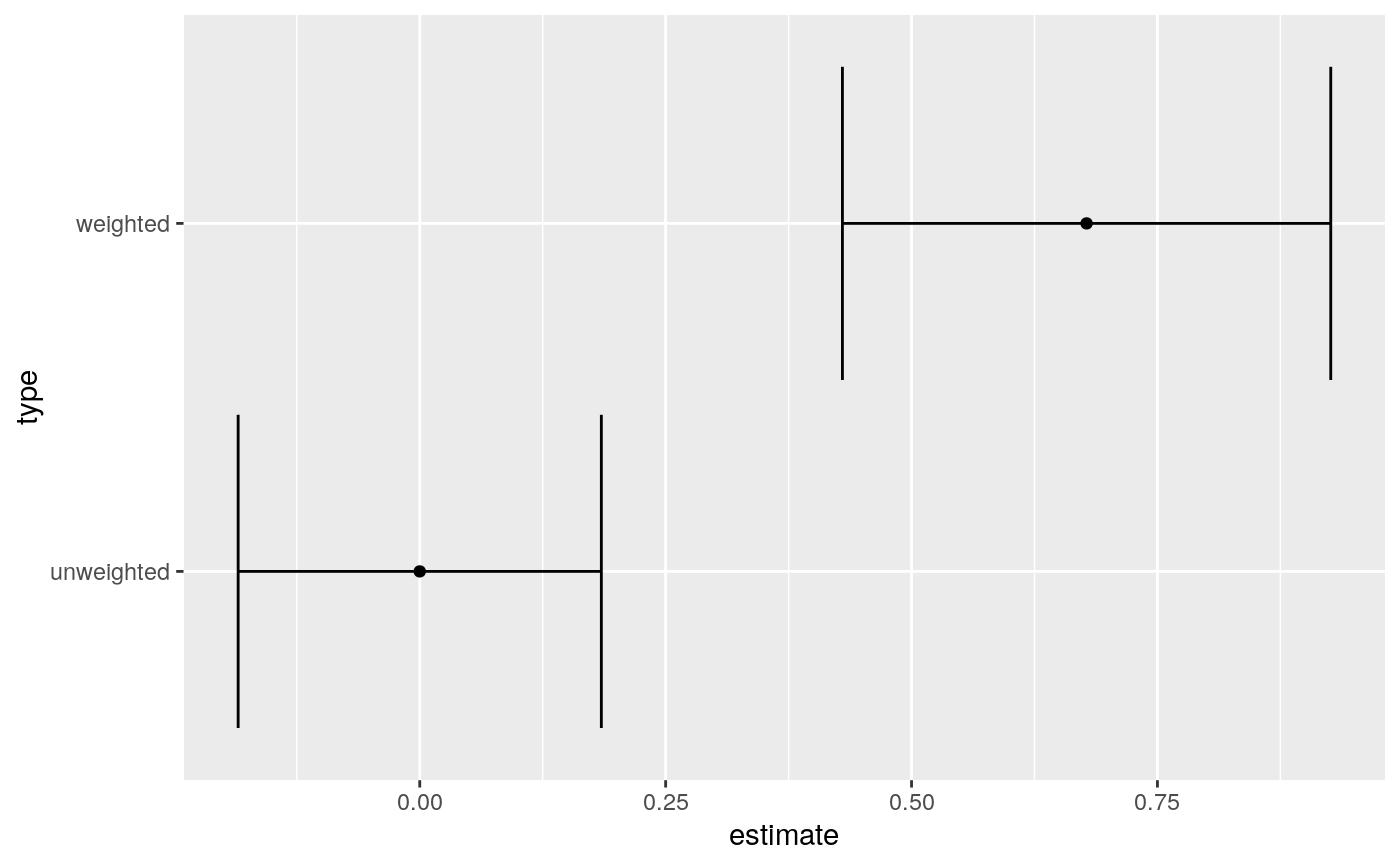
library(psych)#> #>#> #> #>#> #> #>#> #> #>#> #> #>#> #> #>#> #> #>rater1 <- 1:9 rater2 <- c(1, 3, 1, 6, 1, 5, 5, 6, 7) ck <- cohen.kappa(cbind(rater1, rater2)) tidy(ck)#> # A tibble: 2 x 4 #> type estimate conf.low conf.high #> <chr> <dbl> <dbl> <dbl> #> 1 unweighted 0 -0.185 0.185 #> 2 weighted 0.678 0.430 0.926# graph the confidence intervals library(ggplot2) ggplot(tidy(ck), aes(estimate, type)) + geom_point() + geom_errorbarh(aes(xmin = conf.low, xmax = conf.high))