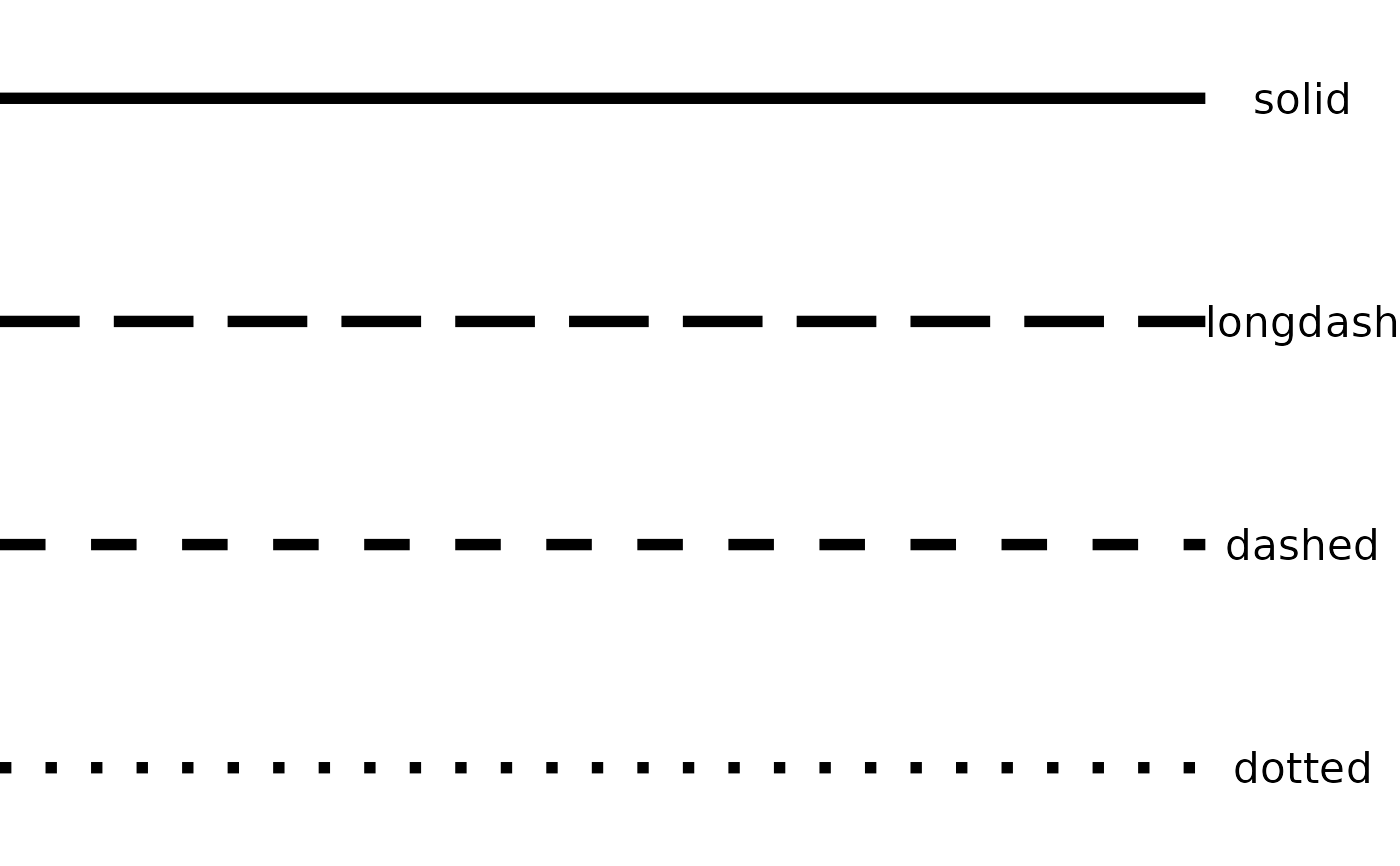
Default line types based on a set supplied by Richard Pearson,
University of Manchester. Continuous values can not be mapped to
line types unless scale_linetype_binned() is used. Still, as linetypes has
no inherent order, this use is not advised.
scale_linetype(..., na.value = "blank")

scale_linetype_binned(..., na.value = "blank")

scale_linetype_continuous(...)

scale_linetype_discrete(..., na.value = "blank")
Arguments
| ... |
Arguments passed on to discrete_scale
paletteA palette function that when called with a single integer
argument (the number of levels in the scale) returns the values that
they should take (e.g., scales::hue_pal()). breaksOne of:
NULL for no breaks
waiver() for the default breaks (the scale limits)
A character vector of breaks A function that takes the limits as input and returns breaks
as output. Also accepts rlang lambda function
notation. limitsOne of:
NULL to use the default scale values
A character vector that defines possible values of the scale and their
order A function that accepts the existing (automatic) values and returns
new ones. Also accepts rlang lambda function
notation. dropShould unused factor levels be omitted from the scale?
The default, TRUE, uses the levels that appear in the data;
FALSE uses all the levels in the factor. na.translateUnlike continuous scales, discrete scales can easily show
missing values, and do so by default. If you want to remove missing values
from a discrete scale, specify na.translate = FALSE. aestheticsThe names of the aesthetics that this scale works with. scale_nameThe name of the scale that should be used for error messages
associated with this scale. nameThe name of the scale. Used as the axis or legend title. If
waiver(), the default, the name of the scale is taken from the first
mapping used for that aesthetic. If NULL, the legend title will be
omitted. labelsOne of:
NULL for no labels
waiver() for the default labels computed by the
transformation object
A character vector giving labels (must be same length as breaks) A function that takes the breaks as input and returns labels
as output. Also accepts rlang lambda function
notation. guideA function used to create a guide or its name. See
guides() for more information. superThe super class to use for the constructed scale |
| na.value |
The linetype to use for NA values. |
Examples