Label percentages (2.5%, 50%, etc)
label_percent(
  accuracy = NULL,
  scale = 100,
  prefix = "",
  suffix = "%",
  big.mark = " ",
  decimal.mark = ".",
  trim = TRUE,
  ...
)

percent_format(
  accuracy = NULL,
  scale = 100,
  prefix = "",
  suffix = "%",
  big.mark = " ",
  decimal.mark = ".",
  trim = TRUE,
  ...
)

percent(
  x,
  accuracy = NULL,
  scale = 100,
  prefix = "",
  suffix = "%",
  big.mark = " ",
  decimal.mark = ".",
  trim = TRUE,
  ...
)
Arguments
| accuracy | A number to round to. Use (e.g.) Applied to rescaled data. |
|---|---|
| scale | A scaling factor: |
| prefix | Symbols to display before and after value. |
| suffix | Symbols to display before and after value. |
| big.mark | Character used between every 3 digits to separate thousands. |
| decimal.mark | The character to be used to indicate the numeric decimal point. |
| trim | Logical, if |
| ... | Other arguments passed on to |
| x | A numeric vector to format. |
Value
All label_() functions return a "labelling" function, i.e. a function that
takes a vector x and returns a character vector of length(x) giving a
label for each input value.
Labelling functions are designed to be used with the labels argument of
ggplot2 scales. The examples demonstrate their use with x scales, but
they work similarly for all scales, including those that generate legends
rather than axes.
Old interface
percent() and percent_format() are retired; please use label_percent()
instead.
See also
Other labels for continuous scales:
label_bytes(),
label_dollar(),
label_number_auto(),
label_number_si(),
label_ordinal(),
label_parse(),
label_pvalue(),
label_scientific()
Examples
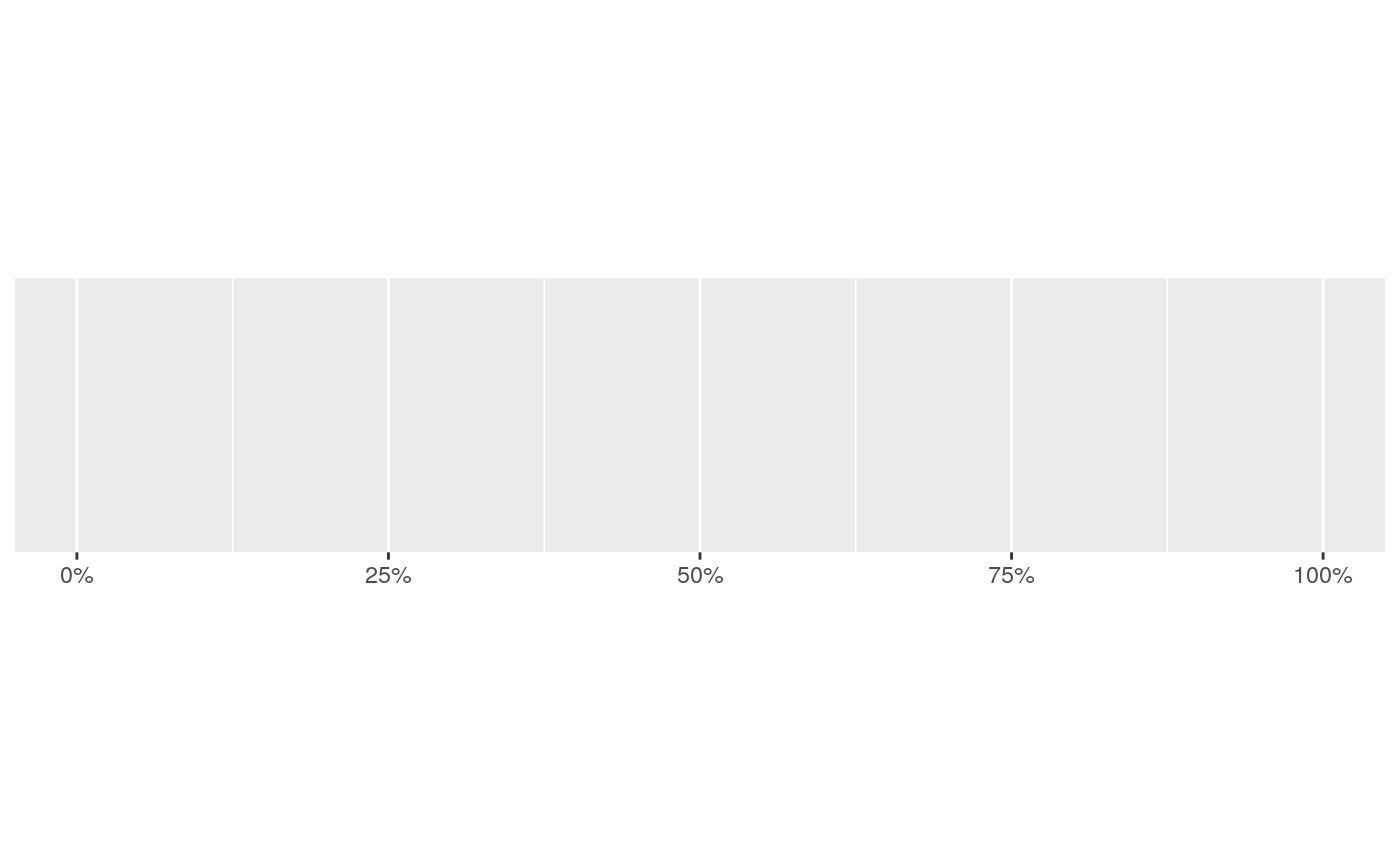
#> scale_x_continuous()#> scale_x_continuous(labels = label_percent())# Use prefix and suffix to create your own variants french_percent <- label_percent( decimal.mark = ",", suffix = " %" ) demo_continuous(c(0, .01), labels = french_percent)#> scale_x_continuous(labels = french_percent)