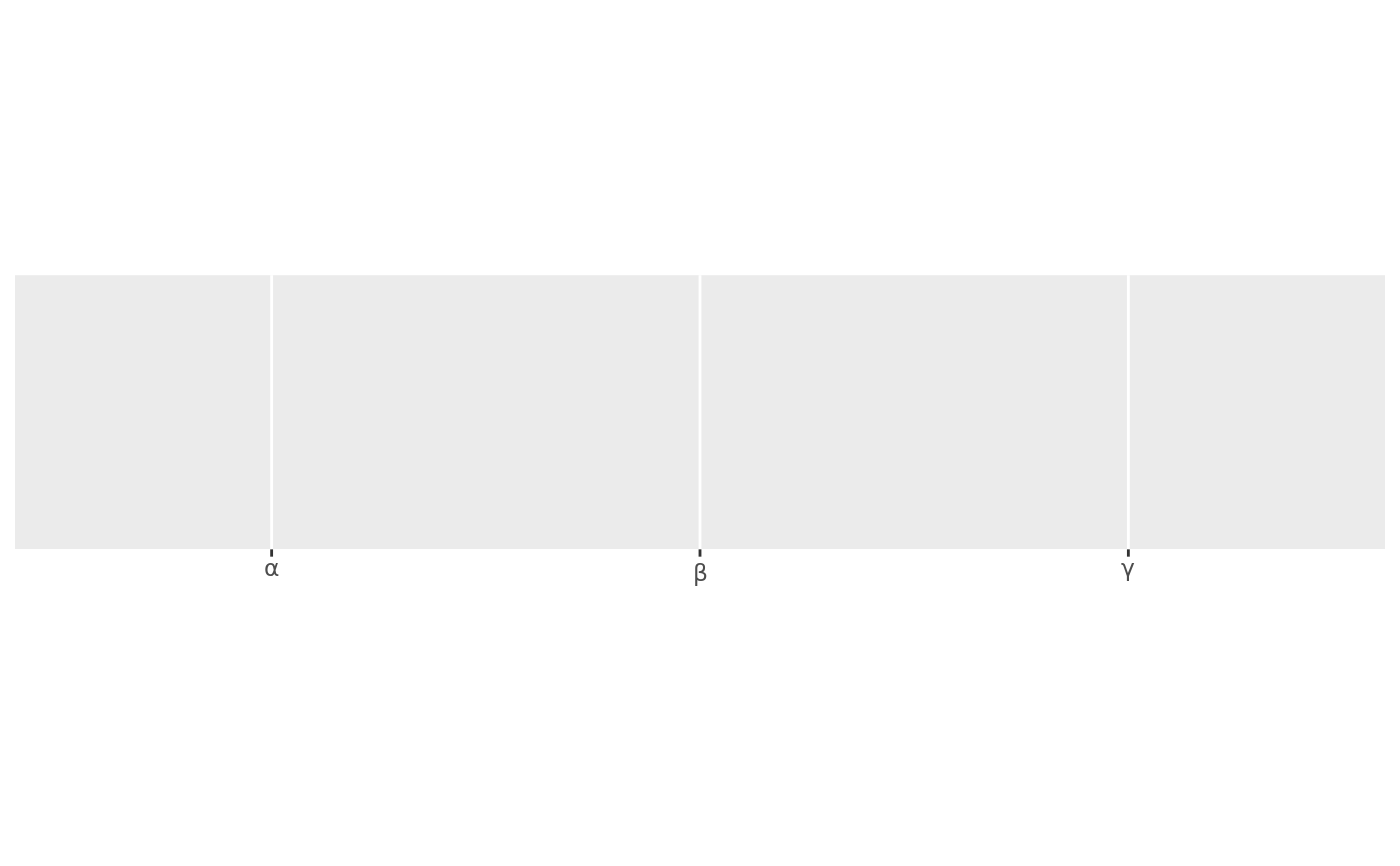
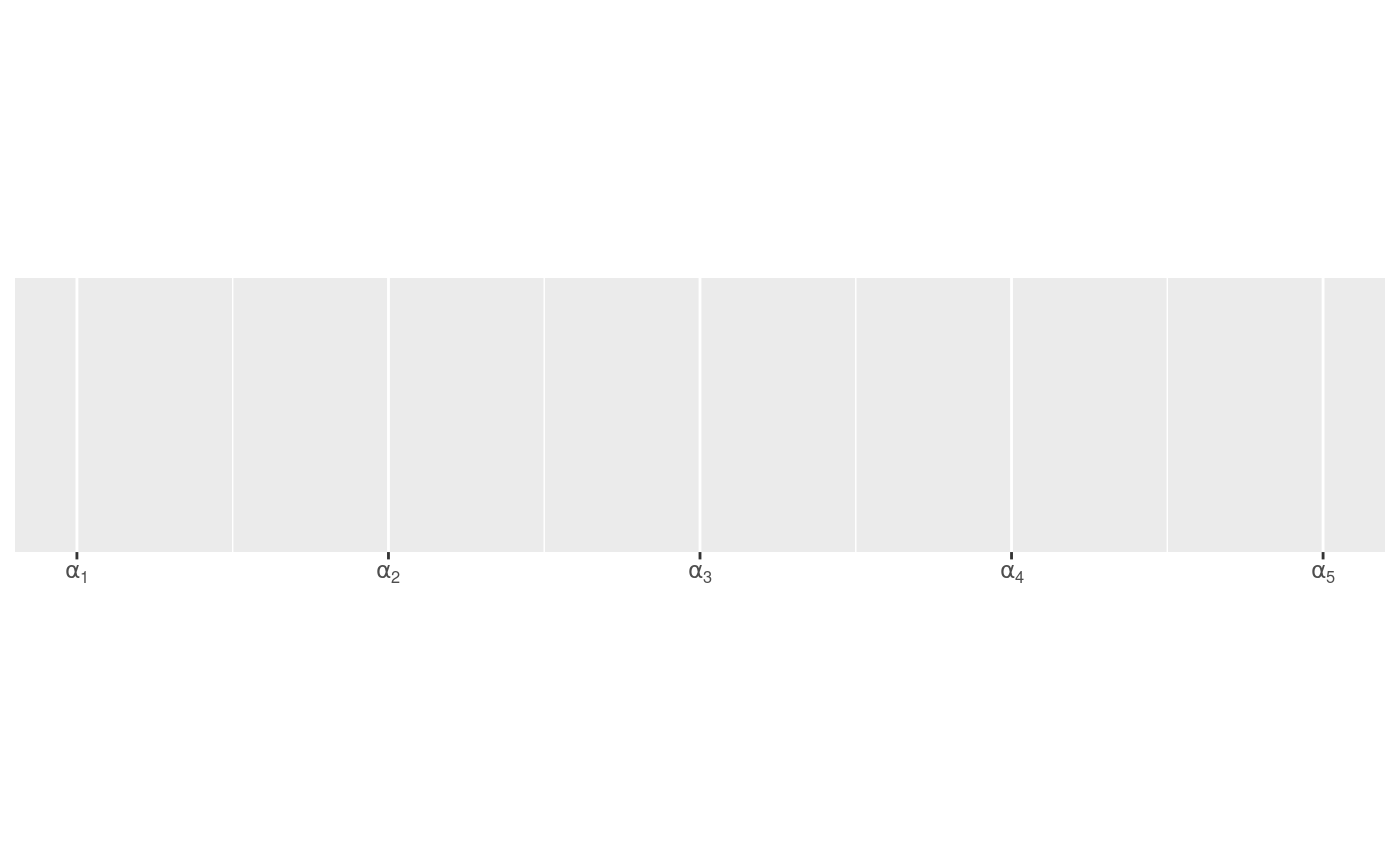
label_parse() produces expression from strings by parsing them;
label_math() constructs expressions by replacing the pronoun .x
with each string.
label_parse()

label_math(expr = 10^.x, format = force)

parse_format()

math_format(expr = 10^.x, format = force)
Arguments
| expr | expression to use |
|---|---|
| format | another format function to apply prior to mathematical transformation - this makes it easier to use floating point numbers in mathematical expressions. |
Value
All label_() functions return a "labelling" function, i.e. a function that
takes a vector x and returns a character vector of length(x) giving a
label for each input value.
Labelling functions are designed to be used with the labels argument of
ggplot2 scales. The examples demonstrate their use with x scales, but
they work similarly for all scales, including those that generate legends
rather than axes.
Old interface
parse_format() and math_format() was retired; please use
label_parse() and label_math() instead.
See also
plotmath for the details of mathematical formatting in R.
Other labels for continuous scales: label_bytes,
label_dollar,
label_number_auto,
label_number_si,
label_ordinal, label_percent,
label_pvalue,
label_scientific
Other labels for discrete scales: label_wrap
Examples
#> scale_x_discrete()#> scale_x_discrete(labels = label_parse())#> scale_x_continuous()#> scale_x_continuous(labels = label_math(alpha[.x]))